Diminutives
A diminutive is a word formed to show that something is small, young, or dear — a booklet is a little book, a duckling is a baby duck, and a kitchenette is a compact kitchen. English builds diminutives by adding endings such as -let, -ling, -ette, -y, -ie, and -kin to an existing word.
This guide groups diminutives by their ending and shows how each one is formed from its root. Along the way you'll spot some surprises — words like 'particle', 'molecule', and 'napkin' are diminutives too, even though their 'parent' words are no longer obvious.
57 entries in this category
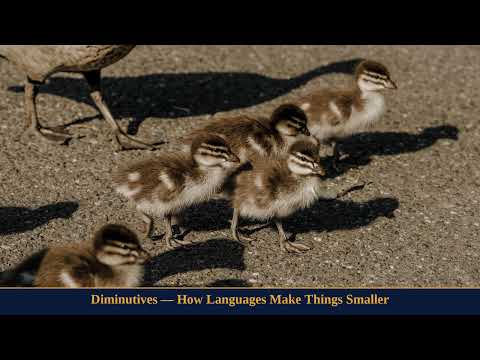
Diminutives in English — How We Shrink Words (Booklet, Duckling, Kitchenette) | @MyProGrammar
Watch on YouTube-ette
11kitchen + -ette
"a small kitchen"
cigar + -ette
"a small cigar"
novel + -ette
"a short novel"
statue + -ette
"a small statue"
usher + -ette
"a female usher"
disk + -ette
"a small disk"
launder + -ette
"a small self-service laundry"
sermon + -ette
"a short sermon"
room + -ette
"a small compartment"
towel + -ette
"a small moist towel"
luncheon + -ette
"a small lunch counter"
-let
13book + -let
"a small book"
pig + -let
"a baby pig"
drop + -let
"a tiny drop"
leaf + -let
"a small leaf / printed sheet"
ring + -let
"a small curl of hair"
star + -let
"a young, minor star"
isle + -let
"a small island"
owl + -let
"a baby owl"
eye + -let
"a small hole or eye"
(river) + -let
"a small stream"
couple + -let
"a pair of lines of verse"
circle + -let
"a small circular band"
cover + -let
"a small bedspread"
-ling
12duck + -ling
"a baby duck"
goose + -ling
"a baby goose"
dear + -ling
"a dear little one"
sap + -ling
"a young tree"
nest + -ling
"a bird too young to leave the nest"
year + -ling
"an animal one year old"
fledge + -ling
"a young bird; a beginner"
weak + -ling
"a weak person or creature"
under + -ling
"a lowly subordinate"
hire + -ling
"a person who works only for pay"
found + -ling
"an abandoned child"
prince + -ling
"a minor prince"
-y / -ie
11dog + -gy
"a little dog (affectionate)"
bird + -ie
"a little bird"
kit(ten) + -y
"a little cat"
dad + -dy
"father (affectionate)"
aunt + -ie
"aunt (affectionate)"
dog + -ie
"a small dog"
pig + -y
"a little pig"
horse + -y
"a child’s word for a horse"
mum + -my
"an affectionate word for mother"
gran + -ny
"an affectionate word for grandmother"
sweet + -ie
"a term of endearment; a small sweet"
Other endings
10lamb + -kin
"a little lamb"
nape + -kin
"a small cloth (orig. 'nape' + -kin)"
maison + -ette
"a small house / flat"
part + -icle
"a tiny part"
cube + -icle
"a small enclosed space"
mole + -cule
"a tiny mass"
globe + -ule
"a tiny drop or ball"
grain + -ule
"a small grain"
node + -ule
"a small lump or node"
man + -kin
"a little man; a model figure"
Frequently asked questions
What is a diminutive?
A diminutive is a word formed to show that something is small, young, or dear. It is usually made by adding a suffix such as -let, -ling, -ette, -y or -ie to a base word — for example, a booklet is a little book, a piglet is a baby pig, and a droplet is a tiny drop.
What are some examples of diminutives?
Common diminutive examples include booklet (a small book), piglet (a baby pig), droplet (a tiny drop), leaflet (a small leaf or printed sheet), ringlet (a small curl of hair), and starlet (a young or minor star). The full list on this page shows how each one is built from its base word.
How are diminutives formed in English?
Most English diminutives are formed with a suffix: -let (booklet, droplet), -ling (duckling, gosling), -ette (kitchenette, cigarette), and -y or -ie for affectionate forms (doggy, birdie). The suffix attaches to a noun to signal smallness, youth, or fondness.
Related lessons & guides
Keep exploring topics closely related to diminutives.